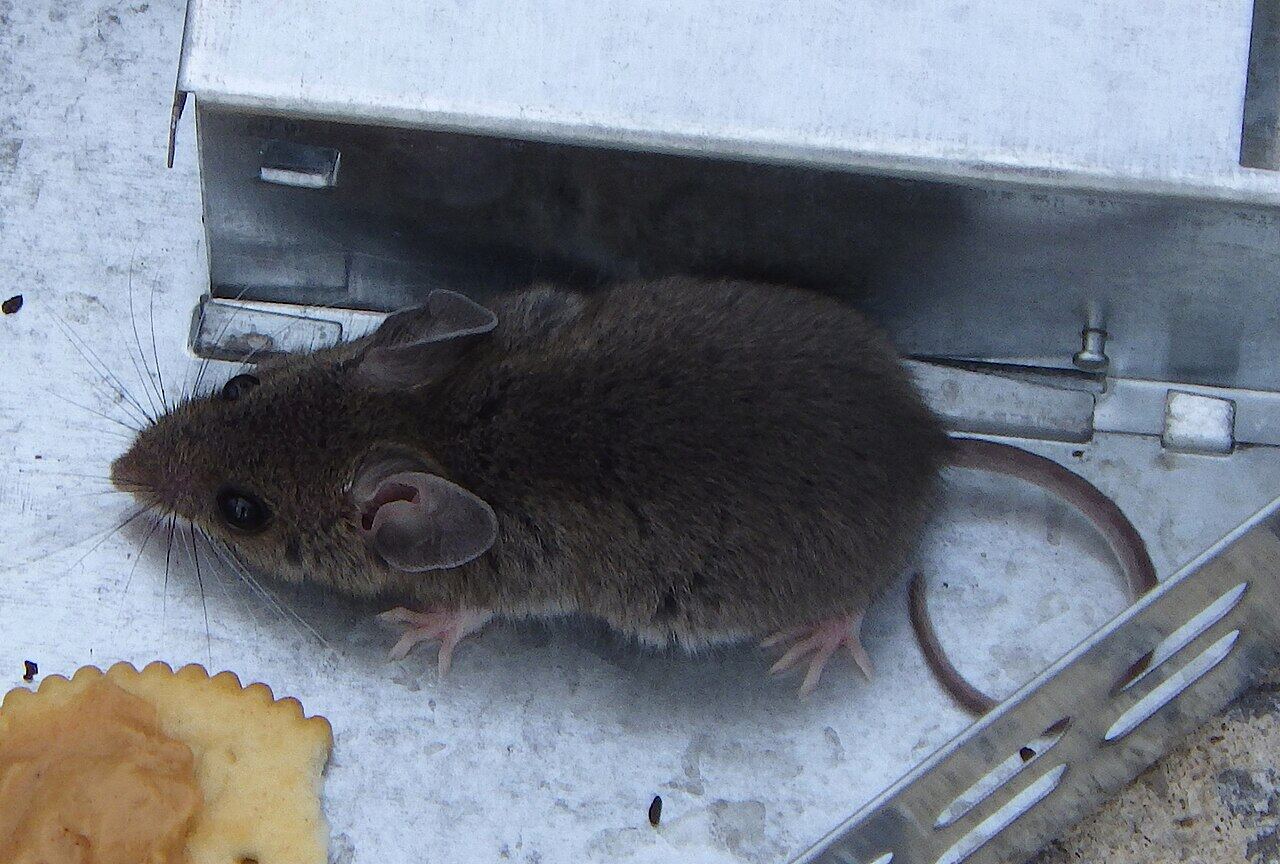
If you hear light scratching in your walls at night, it is most likely house mice. They travel through wall cavities, the spaces between floors and pipe chases, then come out to feed in the kitchen. You usually do not need to open the wall. Set traps where they exit, like under the sink and behind the stove, seal the openings around pipes and fix the entry point in the cellar or rear of the house.
How mice get into walls
Older Baltimore rowhouses have plaster on wood lath, often fastened over furring strips on brick. That leaves narrow spaces behind the plaster. The joist bays between floors connect them. Radiator pipes, plumbing, gas lines and wiring pass through holes in floors and walls, giving mice a path from the cellar to the top floor.
Newer houses in the county have drywall over studs, with gaps where pipes go through the bottom plate under sinks and behind tubs.
UC IPM notes mice can squeeze under gaps a quarter inch tall. The CDC says a hole the width of a pencil is enough. Most walls have many openings that size.
Is it mice or something else?
Mice make light, fast scratching that moves along a wall or across a ceiling, usually after dark. You may hear tiny squeaks or the sound of something rolling. Rats are heavier, with louder scratching, thumping and gnawing, usually lower in the house near the cellar.
Check for droppings near the wall, under the sink or behind appliances. Rice-grain droppings mean mice. See rodent noises at night and rat droppings vs mouse droppings.
Find where they come out
Mice live in the wall but feed in the room. Look at the spots where the wall void opens into living space:
- Under the kitchen sink, where pipes go into the wall or floor
- Behind and under the stove, dishwasher and refrigerator
- Inside base cabinets, at the back corners
- Where radiator pipes go through the floor
- Gaps at baseboards, especially on outside walls
- Inside closets where plumbing rises
Droppings and grease marks near one of those spots show you an exit. That is where the traps go.
Trap at the exits
Set snap traps at each exit, along the wall, with the trigger toward the wall. UC IPM says snap traps work well in most situations, and that the best bait is often the food the mice are already eating. Peanut butter works, and a bit of cotton or dental floss attracts females looking for nesting material.
Use several traps a few inches to a few feet apart. Check them daily. Keep traps in covered boxes where kids and pets can reach.
Avoid putting loose bait into the wall. Mice that eat bait in a wall often die there, and the smell can last for weeks. See dead rodent smell.
Seal, but in the right order
Once the catches slow, seal the interior openings: around pipes under sinks, behind appliances, at radiator pipes and at baseboard gaps. Leave one or two exits with traps until catches stop, then seal those too.
Then find the outside or cellar entry that feeds the wall. Common spots in a rowhouse are pipe entries in the cellar wall, the joint under a rear kitchen addition and gaps around a dryer vent. Seal with steel wool or copper mesh plus sealant for small gaps and hardware cloth or sheet metal for larger ones. UC IPM notes that foam, plastic and rubber alone do not stop mice. See steel wool vs copper mesh.
When the source is next door
In an attached rowhouse, the mice in your wall may live next door. They travel along pipes and through gaps at the party wall, floor and ceiling. If the noises come from a shared wall, or started when a neighbor began renovating, the source may be on their side.
You can still seal the openings on your side and trap at your exits. If both houses have activity, treating them together works much better. See mice in walls removal.
A note on plaster walls
Many Baltimore rowhouses still have their original plaster. Plaster is harder to patch than drywall, so avoid cutting into it unless you have to. Most of the time, you can reach the mice where they come out instead of where they live. If a dead mouse is in a plaster wall, a technician can often go in through the ceiling below, a closet or a baseboard instead of the main wall.
When to get help
Call a provider if the noises keep coming back after a few weeks of trapping, if you smell something dead in the wall, if mice show up in several rooms or on several floors, or if you rent and need it documented. A technician can find the entry point, seal it properly and handle a dead mouse if needed.