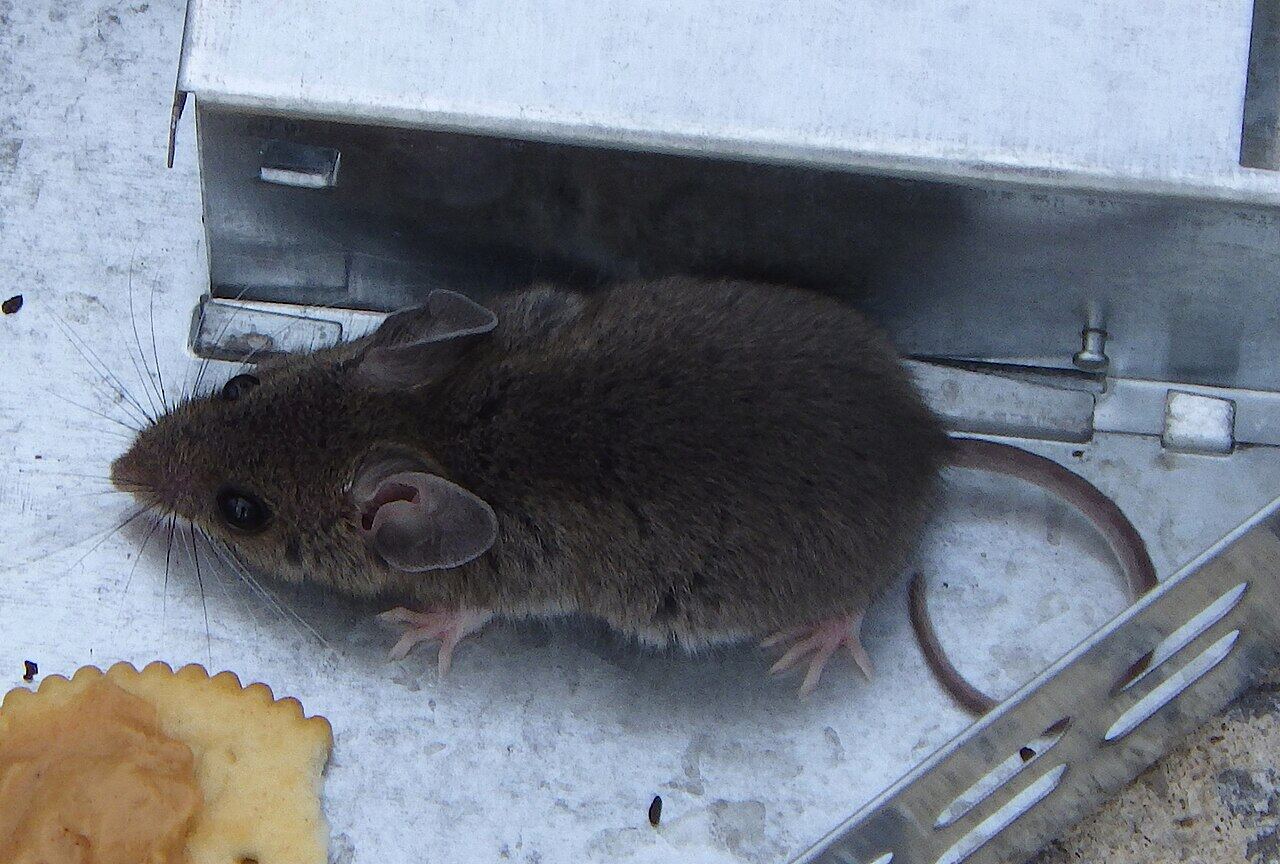
Scratching, scurrying or light gnawing inside a wall or ceiling at night is usually house mice. In Baltimore rowhouses they travel the gaps between plaster and brick, the space between floors and the chases where pipes and wires run. Getting them out means finding where they enter the void and where they come out to feed, trapping at those points and sealing the openings.
How mice get into Baltimore walls
In an older rowhouse, interior walls are often plaster on wood lath, and exterior and party walls may have plaster applied over furring strips on brick. That leaves narrow spaces mice can run through. The joist bays between floors connect them. Radiator and plumbing pipes, gas lines and old knob-and-tube or newer wiring all pass through holes that give mice a highway from the cellar to the top floor.
In newer houses in the county, the voids are drywall over studs, with gaps where plumbing comes through the bottom plate under sinks and behind tubs.
Sounds tell you a lot. Light, quick scratching that moves along a wall after dark is mice. Heavier thumps and gnawing low in a wall near the cellar can be rats. Read rodent noises at night to narrow it down.
What a thorough wall job includes
Ask for these steps:
- Tracing the activity: where you hear it, where droppings show up and where pipes enter the wall
- Trapping at the points where mice leave the wall to feed, such as under the sink, behind the stove and dishwasher, at the radiator pipe and inside base cabinets
- Sealing interior openings around pipes, radiator lines, and gaps at baseboards and cabinet backs
- Sealing the exterior or cellar entry that feeds the wall
- Avoiding loose bait inside walls, since mice that eat it often die there
- A return check to confirm the sounds and droppings have stopped
Opening walls is rarely needed for live mice. It may be needed for a dead one. See dead rodent removal.
Step by step
- You note when and where you hear the sounds, and the technician maps them against the plumbing and heating lines.
- The cellar and outside walls are inspected for the entry point.
- Traps go at the spots where the wall void opens into living space.
- Interior penetrations get sealed except one or two exit points, where traps keep working.
- Once catches stop, the last openings are sealed.
- Exterior and cellar entries get sealed so new mice cannot reach the void.
Expect the noise to drop within a week or two if the entry has been found. If it keeps coming back from one wall, the source may be the house next door.
Why walls are harder in a rowhouse
Shared walls are the main issue. If the house next door has mice, they can reach your walls from their side through pipe holes and gaps at the floor and ceiling lines. Sealing your exterior does nothing about that. A good technician seals the interior openings on your side of the party wall and tells you if the source looks like it is next door.
Renovations push mice around too. When a neighbor guts a house, the mice in it go looking for new space, and the closest space is your wall. If the noises started right after work began next door, mention it.
What not to do
Do not put loose bait into wall openings. Mice that eat it die in the wall, and the smell can last weeks. Avoid ultrasonic plug-ins as a fix; research has not shown that they keep rodents out for long. See do rodent repellents work. Do not seal every opening at once while mice are still inside, or they will chew new exits or die in the void.
What it costs
Price depends on how many rooms are involved, how many openings need sealing and whether a dead mouse has to be cut out of a wall. Angi lists exclusion work in Baltimore at about $158 to $473 for most jobs and follow-up visits at about $40 to $120. Ask for a written quote that lists trapping visits and sealing separately so you know what you are paying for.